
Concrete work leaves very little room for error. Order too little and you have a cold joint in the middle of a driveway; order too much and you pay for a truckload you have to wash out. A clear concrete estimate template records the slab dimensions, thickness, cubic yards, reinforcement, finish and every cost that goes into the pour, so your customer understands the price and you know the job will make money. This page has five free concrete quote templates in Word, Excel and PDF, a cubic yard calculator, and a full guide to estimating driveways, patios, slabs, footings and stamped concrete.
Enter your slab sizes in the calculator, then choose the template that fits the job.
Free Concrete Estimate Calculator (Cubic Yards & Cost)
Enter each slab or pour by length, width and thickness to get cubic yards with overage, then price the concrete, rebar, finishing and pump.
| Slab / pour | Length (ft) | Width (ft) | Remove |
|---|
Ready-mix is ordered in quarter yards here; check your supplier’s minimum load. Nothing you type is saved or sent anywhere.
5 Free Concrete Quote Templates (Word, Excel & PDF)
Each template is built for a different type of concrete work. The Excel cubic yard estimator calculates volume from length, width and depth and rounds the order to the nearest quarter yard. The driveway estimate includes a mix and site specification with PSI, slump, fibre, rebar and cure time. The commercial bid form has the bid bond, architect and inclusions and exclusions fields general contractors expect. The stamped patio quote has a pattern and colour strip and a care table, and the Excel footings and garage slab quote adds a pour schedule with inspection hold points. All five are different designs, and they open in Word, Excel, Google Docs and Google Sheets.
1. Concrete Cubic Yard Estimator (Excel)
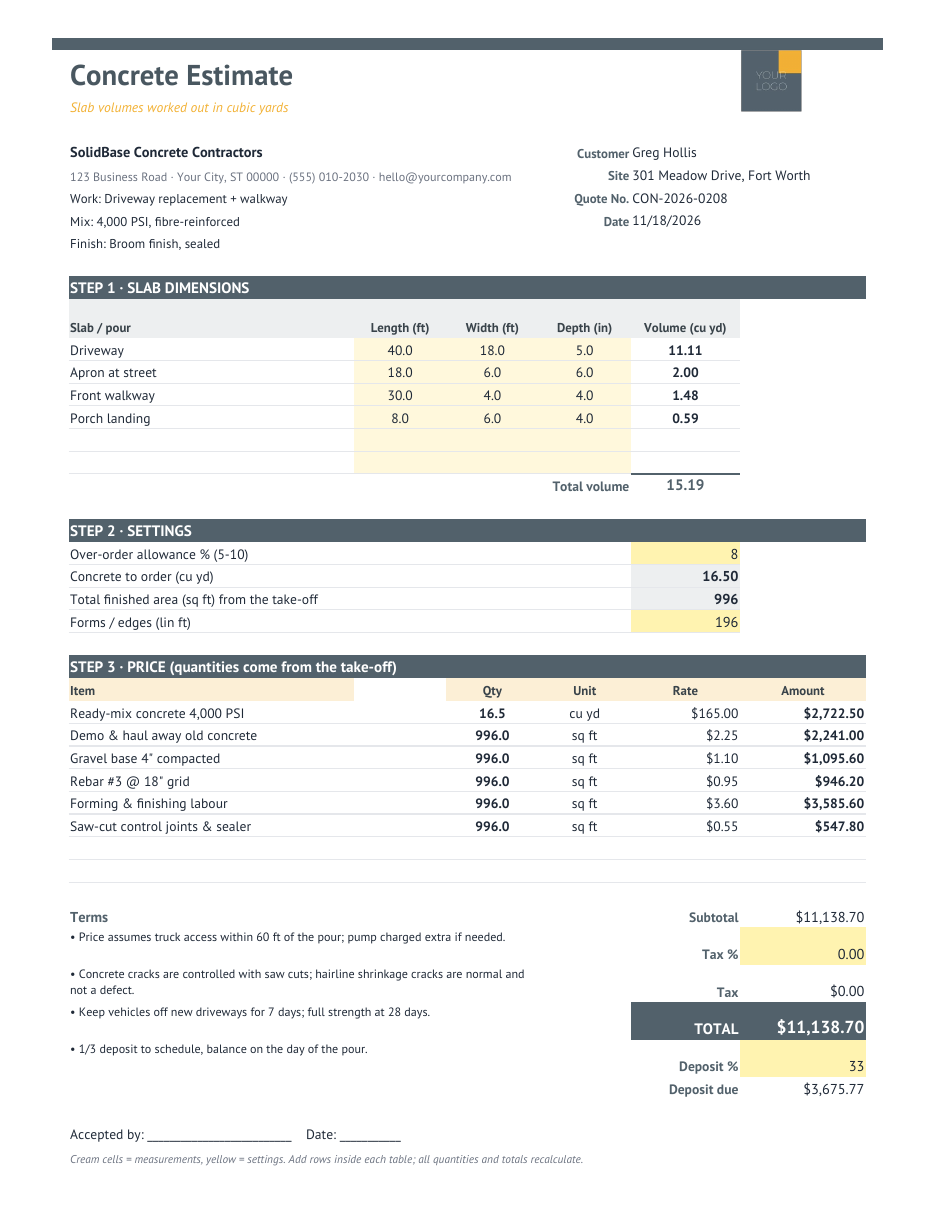
List each slab's length, width and depth in inches and the sheet calculates cubic yards, adds an over-order allowance, rounds to the nearest quarter yard and prices demo, base, rebar, finishing and sealing. Best for driveways, patios and slabs.
Download Excel (.xlsx)Download PDF2. Concrete Driveway Estimate
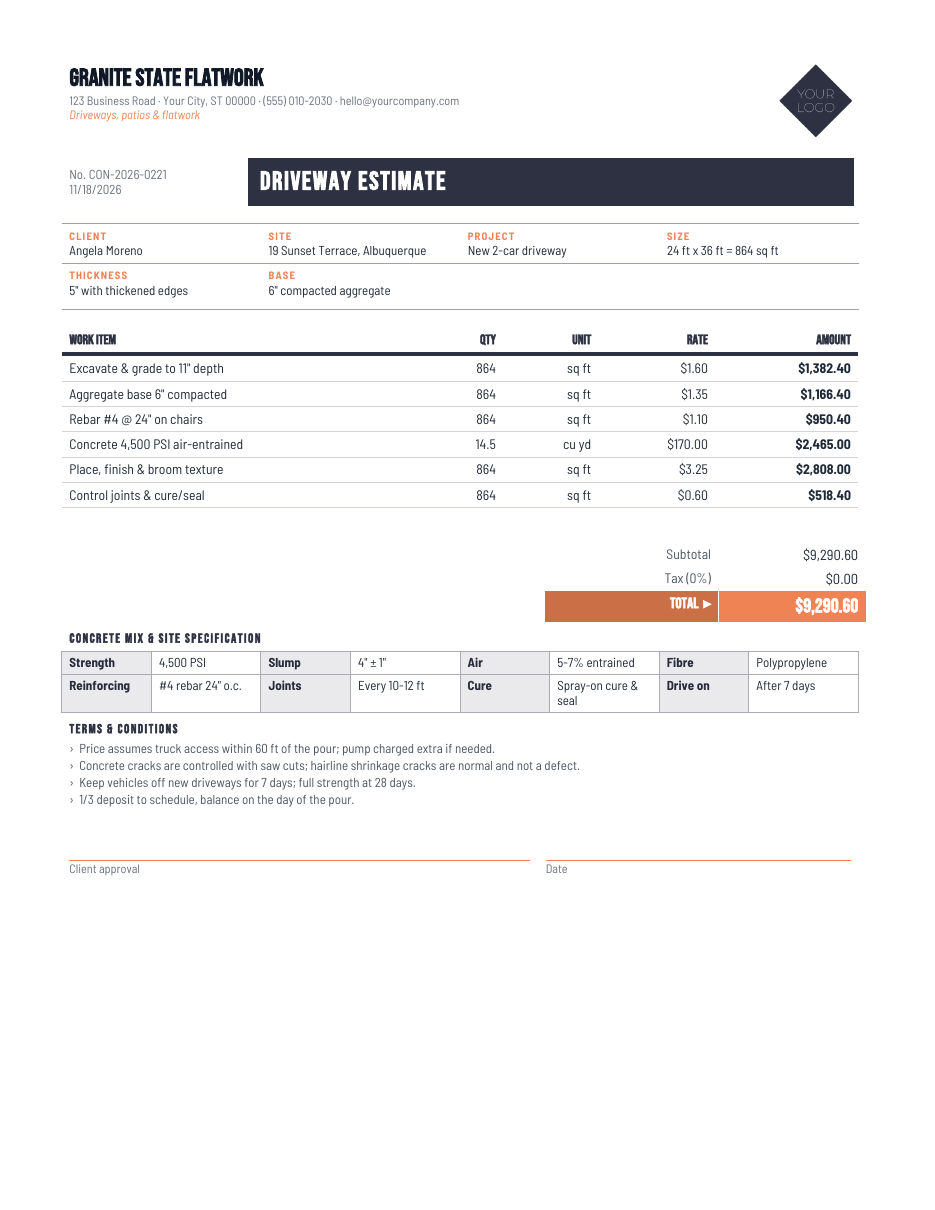
Gunmetal and coral with a ribbon title strip, an excavation-to-sealer price table and a 4-column mix and site specification (PSI, slump, air, fibre, rebar, joints, cure, drive-on time). Best for residential driveway replacement.
Download Word (.docx)Download PDF3. Commercial Concrete Bid Form
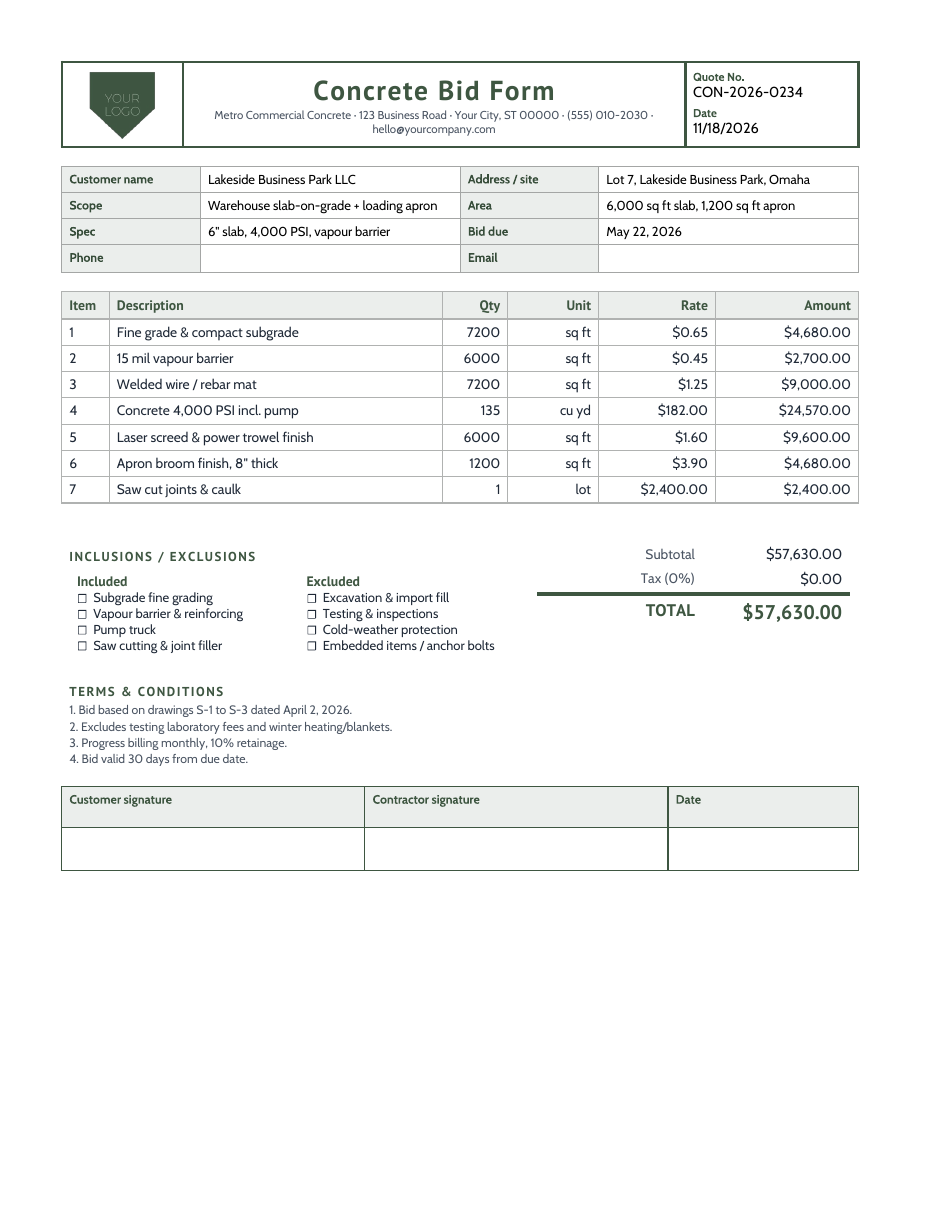
A boxed olive and gold bid form with architect, bid bond and due-date fields, numbered slab-on-grade lines and an inclusions / exclusions checklist that general contractors expect. Best for commercial slabs and GC bid packages.
Download Word (.docx)Download PDF4. Stamped Concrete Patio Quote
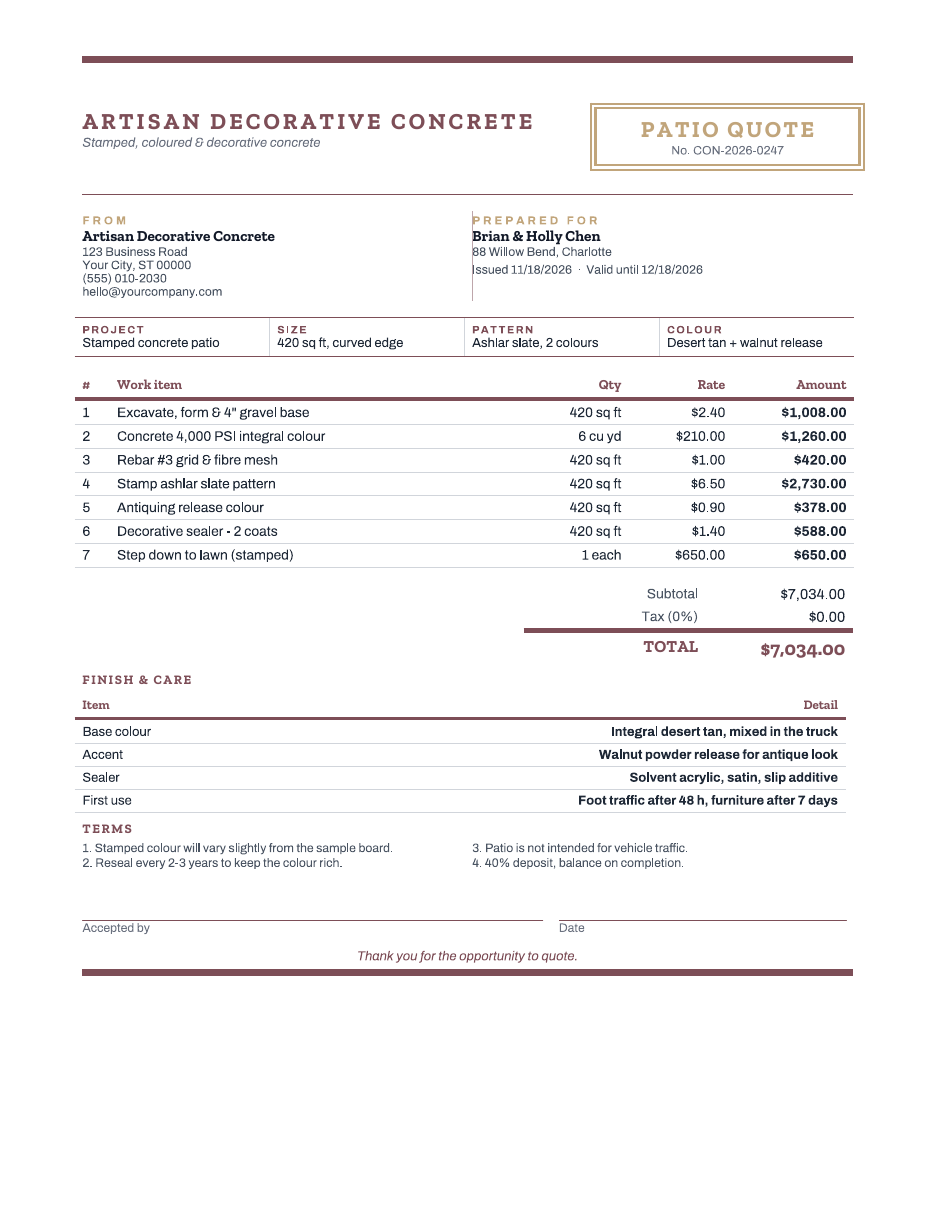
An editorial layout with heavy rules, a double-bordered stamp title box, From / Prepared-for columns, a pattern and colour strip and a finish and care table. Best for stamped and decorative concrete.
Download Word (.docx)Download PDF5. Footings & Garage Slab Quote (Excel)
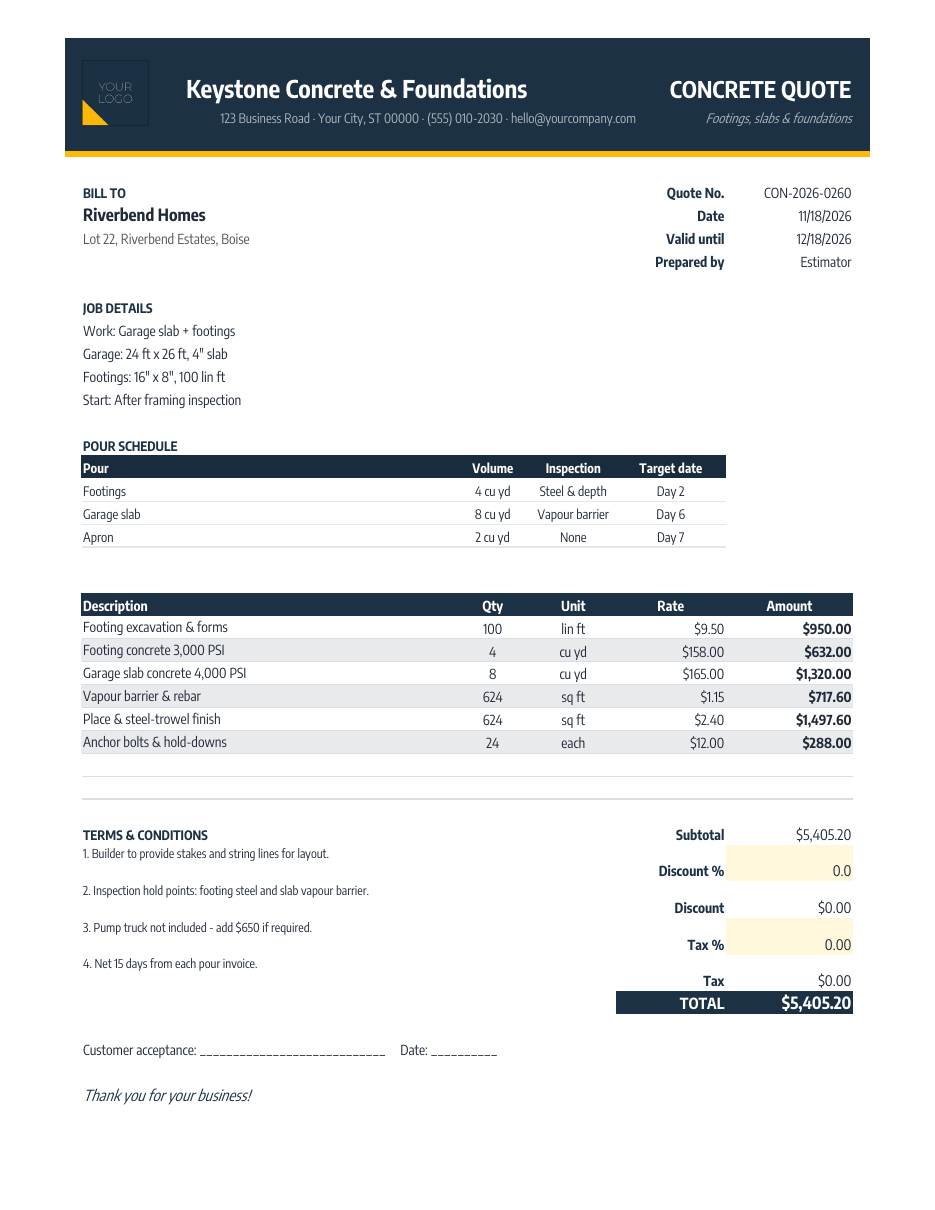
Navy and amber Excel quote for builders with a pour schedule (pour, volume, inspection, target date), zebra line items and automatic discount, tax and total. Best for builders and new-home concrete work.
Download Excel (.xlsx)Download PDFWhat Is a Concrete Estimate?
A concrete estimate is a written price from a concrete contractor for forming, placing and finishing concrete. It can be for a driveway, patio, sidewalk, garage slab, house foundation, footings, retaining wall, steps or a decorative stamped or exposed-aggregate surface. It lists the area and thickness, the volume of concrete, the reinforcement, the base preparation, the finish, and the labour and equipment, and it ends with a total price and terms. Builders also use concrete estimates to budget the foundation stage of a larger construction estimate.
What to Include in a Concrete Quote
- Contractor details: company name, logo, licence and insurance, phone and email.
- Customer and site: name, address, access for the truck and pump, and where the washout will be.
- Scope and dimensions: each slab or pour with length, width, thickness and the resulting square feet and cubic yards.
- Demolition and excavation: breaking out and hauling old concrete or asphalt, digging to depth and grading.
- Base: compacted gravel thickness and type, and any vapour barrier under interior slabs.
- Concrete mix: strength in PSI, air entrainment for freeze-thaw areas, fibre, and admixtures such as accelerators in cold weather.
- Reinforcement: rebar size and spacing, wire mesh or fibre, dowels into existing slabs.
- Forms and finish: forming, broom, smooth trowel, stamped, coloured or exposed aggregate, and control joint spacing.
- Curing and sealing: curing compound, sealer and when the slab can be walked or driven on.
- Pump and delivery: pump truck, short-load fees and Saturday delivery charges.
- Terms: permit, inspections, weather delays, cracking disclaimer, payment schedule and validity.
How to Calculate Concrete for an Estimate
Step 1: Calculate the area
Multiply length by width for each rectangular section. Split irregular shapes into rectangles and triangles and add them up.
Step 2: Convert to cubic yards
Multiply the area in square feet by the thickness in inches divided by 12 to get cubic feet, then divide by 27. A 24 by 24 ft garage slab at 4 inches thick is 576 sq ft x 0.333 ft = 192 cubic feet, or 7.11 cubic yards. The Excel estimator does this for every slab in the list.
Step 3: Add overage
Add 5 to 10% for uneven sub-grade, spillage and form bulges, then round up to the nearest quarter or half yard depending on how your ready-mix supplier sells it. Check the supplier’s minimum load and short-load fee for small pours.
Step 4: Price materials, labour and equipment
Multiply the yards by the delivered price per yard. Price rebar or mesh, base gravel and forms per square foot or by the actual material list, and labour for placing and finishing per square foot. Add a pump truck where the truck cannot reach, plus sealer, saw-cutting and clean-up.
Step 5: Add overhead, profit and contingency
Concrete contractors usually add 15 to 25% for overhead and profit. On demolition jobs, add a contingency for thicker-than-expected old slabs or buried debris.
Concrete Estimate Example
A sample estimate for a 40 by 12 ft driveway and a 24 by 4 ft walkway, both 4 inches thick:
- Area: 576 sq ft, 7.11 cubic yards, ordered as 7.75 yards with 8% overage
- Ready-mix at $165 per yard: $1,278.75
- Rebar on chairs at $0.90 per sq ft: $518.40
- Forms and 4-inch compacted gravel base at $1.10 per sq ft: $633.60
- Place and broom finish labour at $2.60 per sq ft: $1,497.60
Total $3,928.35, or about $6.82 per square foot before tax. Adding the price per square foot helps homeowners compare your quote with others that are only quoted per foot.
Pricing Decorative and Stamped Concrete
Decorative work is priced very differently from plain grey flatwork. A stamped patio needs colour hardener or integral colour, release agent, stamp mats, extra finishers on the day of the pour and a sealer coat once it cures. Many contractors price stamped concrete at roughly double the rate of a broom finish per square foot, and they list each decorative step so the customer understands why. The stamped patio template has a pattern and colour strip for the chosen stamp, base colour and release colour, plus a finish and care table that explains resealing every two to three years.
Exposed aggregate, salt finishes, coloured borders and saw-cut patterns should also appear as separate lines or options. That way the customer can see what each feature adds and drop one if the budget is tight, without you having to rewrite the estimate.
Demolition and Replacement Jobs
Replacing an old driveway or patio adds work that new-build pours do not have. Price the break-out per square foot, include the dumpster or truck haul to a recycling yard, and allow for removing the old base if it has failed. Old slabs are sometimes thicker than expected or contain rebar, so state your assumption about thickness and price any extra as a change order. This one note prevents a lot of difficult conversations once the jackhammer starts.
Residential vs Commercial Concrete Quotes
Residential quotes are usually short and visual. Homeowners want to see the finish, colour and pattern, and they need to know when they can drive on the new driveway. The driveway and stamped patio templates put these details up front.
Commercial concrete work is normally bid against drawings and a specification. General contractors expect a bid form with the bid number, addenda received, bid bond, a numbered schedule of values and clear inclusions and exclusions such as testing, winter protection and pump. The commercial bid form template follows that structure, and the bid quote template and construction quote template help with other trades on the same tender.
Tips for Accurate Concrete Estimates
- Measure thickness at several points. Sub-grade is rarely perfectly level, and an extra half inch over a large slab adds up to yards of concrete.
- Confirm access. If the ready-mix truck cannot reach the forms, you need a pump or wheelbarrows, and both add cost and labour.
- Write a cracking clause. Concrete cracks; explain control joints and that hairline cracks are not defects.
- Plan the weather. Note how you handle rain, heat and freezing temperatures, including blankets and accelerators.
- Schedule inspections. Footings and slabs often need an inspection before the pour; the footings template includes a pour schedule with hold points.
- Keep your rates in one place. A simple price quote template or the Excel quotation template makes a handy price book for your standard items.
Frequently Asked Questions
How do you calculate cubic yards for a concrete estimate?
Multiply length by width in feet, multiply by the thickness in inches divided by 12, and divide the result by 27. For example, a 20 by 20 ft slab 4 inches thick is 400 x 0.333 / 27 = 4.94 cubic yards. Add 5 to 10% overage before ordering.
What should a concrete quote include?
It should include the area and thickness of each pour, cubic yards, the concrete mix, reinforcement, base preparation, forms, the finish, curing and sealing, pump and delivery fees, permits, labour and a total price with payment terms and a validity date.
Is there a concrete estimate template in Excel?
Yes. The cubic yard estimator and the footings and garage slab quote are both Excel workbooks with formulas for volume, overage, line totals, discount and tax. They also open in Google Sheets.
How much overage should I order for concrete?
Most contractors add 5 to 10%. Use the higher end for irregular sub-grades, thick slabs and footings, and the lower end for well-compacted, laser-levelled bases.
Should I quote concrete per square foot or per job?
Many contractors give a total job price but also show the price per square foot so homeowners can compare. For commercial work, follow the bid form and break the price into the line items requested by the general contractor.
How long is a concrete quote valid?
Thirty days is common, but ready-mix and rebar prices can change quickly. State the validity date and note that prices may be adjusted if the supplier raises its rates before the pour.
