
Homeowners usually collect three or four fence quotes before they choose a contractor, and they compare them line by line. A clear fence estimate template shows the measured length, the material, the number of posts and gates, removal of the old fence and the total price in a way that is easy to compare and hard to argue with. This page gives you five free fence quote templates in Word, Excel and PDF, a calculator that counts posts, panels and concrete, and a step-by-step guide to estimating fence installation and fence repair work.
Enter your fence runs in the calculator, then pick the fence quote template that matches the job.
Free Fence Estimate Calculator (Posts, Panels & Cost)
Enter each fence run to count the posts, panels or pickets and concrete you need, then add gates, labour and removal for a complete fence estimate.
| Fence run | Length (ft) | Remove |
|---|
Each run counts its own end posts; shared corners make the real count slightly lower. Nothing you type is saved or sent anywhere.
5 Free Fence Quote Templates (Word, Excel & PDF)
The five templates are designed for different fencing jobs. The Excel linear-foot estimator counts sections, posts, pickets, rails and concrete bags from each run you enter. The vinyl fence installation quote has a picket-fence banner and a layout and site notes block for survey pins, the 811 ticket, HOA approval and gate swing. The options quote compares wood, vinyl and aluminium for the same run with the recommended material highlighted. The fence repair job ticket is a compact form for storm damage and post replacement, and the Excel farm and ranch quote handles barbed wire, T-posts and H-braces by the roll and by the foot. Each one is a distinct design you can brand and save as PDF.
1. Fence Linear Foot & Materials Estimator (Excel)
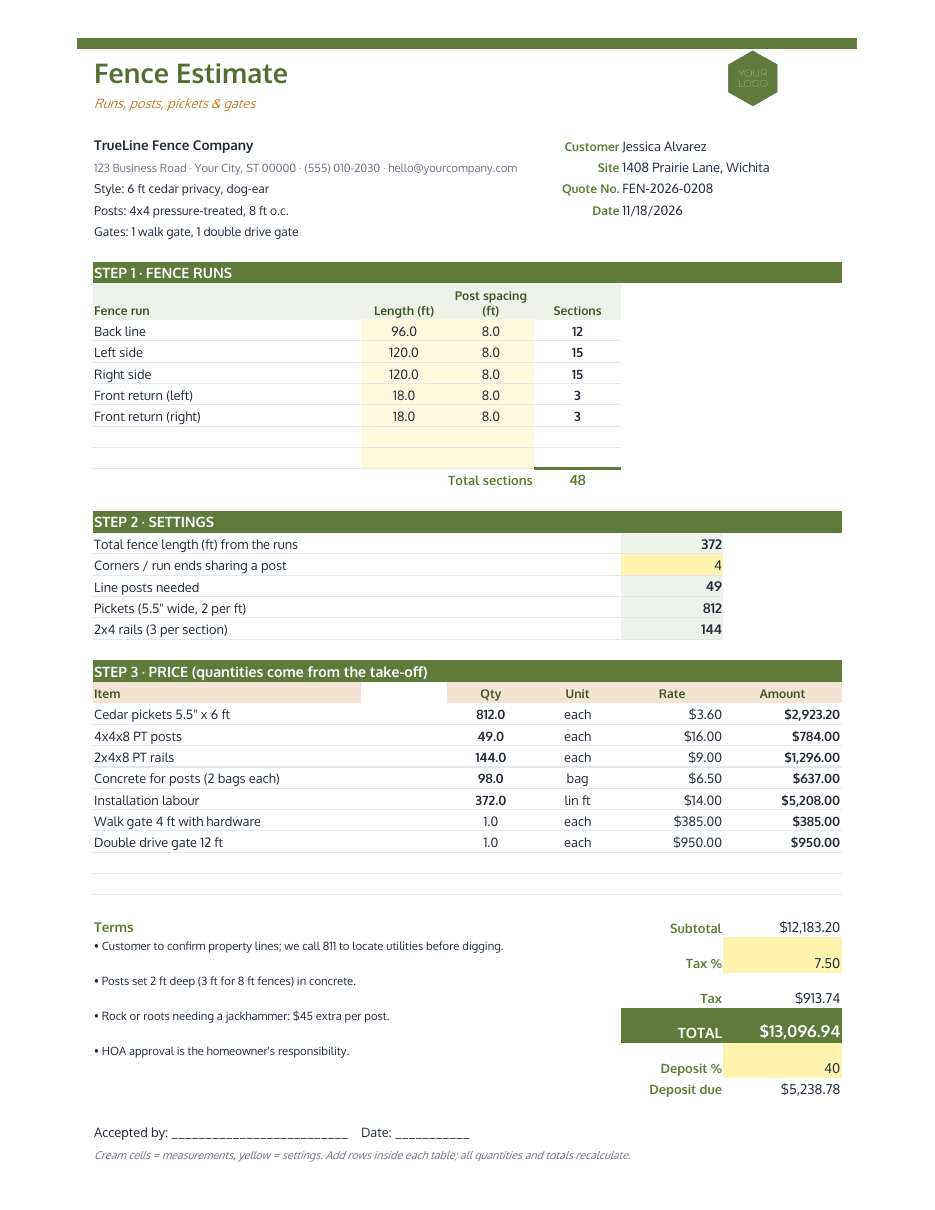
Enter each fence run and post spacing and the sheet counts sections, posts, pickets, rails and concrete bags, then prices materials, labour and gates with formulas. Best for wood privacy and picket fence quotes.
Download Excel (.xlsx)Download PDF2. Vinyl Fence Installation Quote
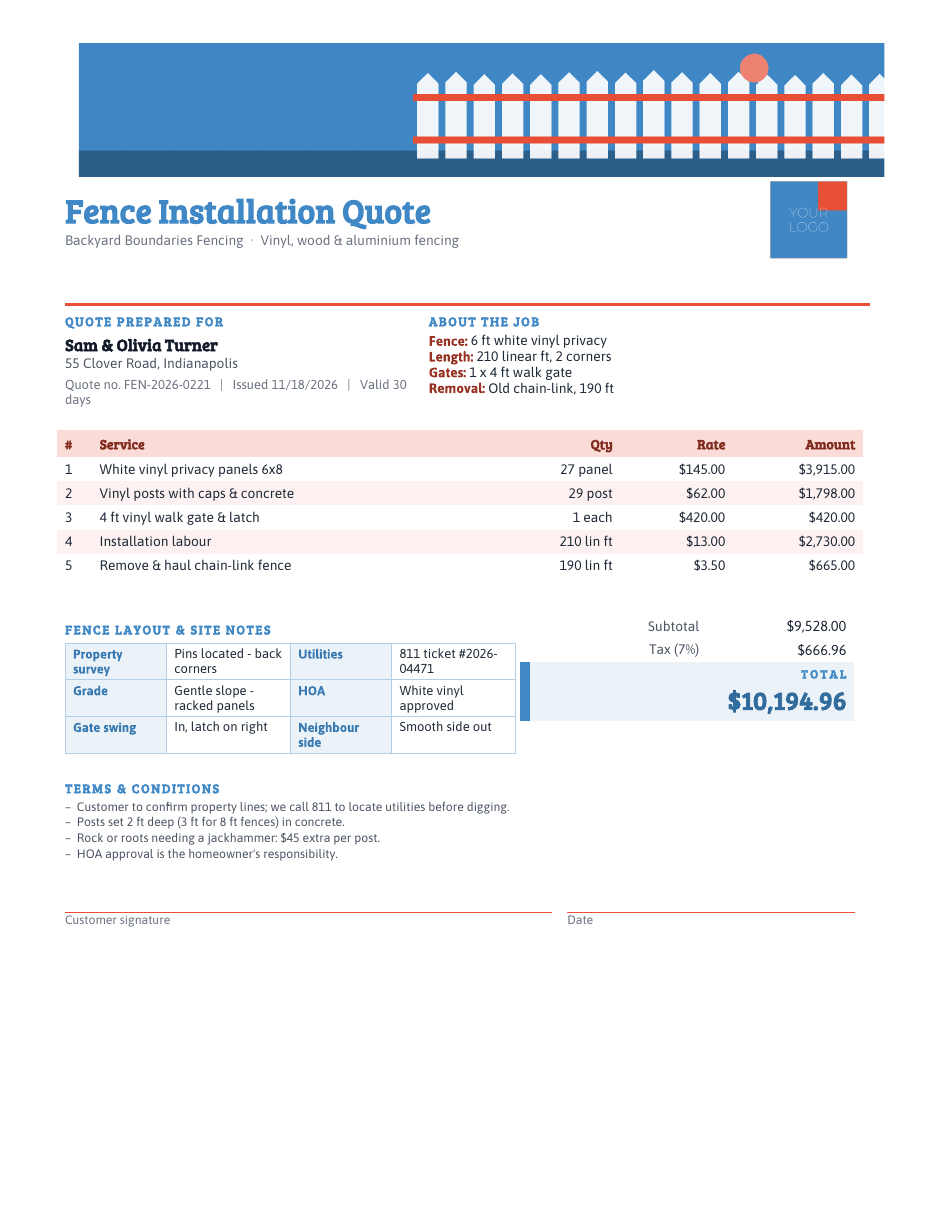
A bright picket-fence banner, panel, post and gate pricing and a layout and site-notes block (survey pins, 811 ticket, grade, HOA approval, gate swing). Best for residential fence installs.
Download Word (.docx)Download PDF3. Wood vs Vinyl vs Aluminum Fence Options
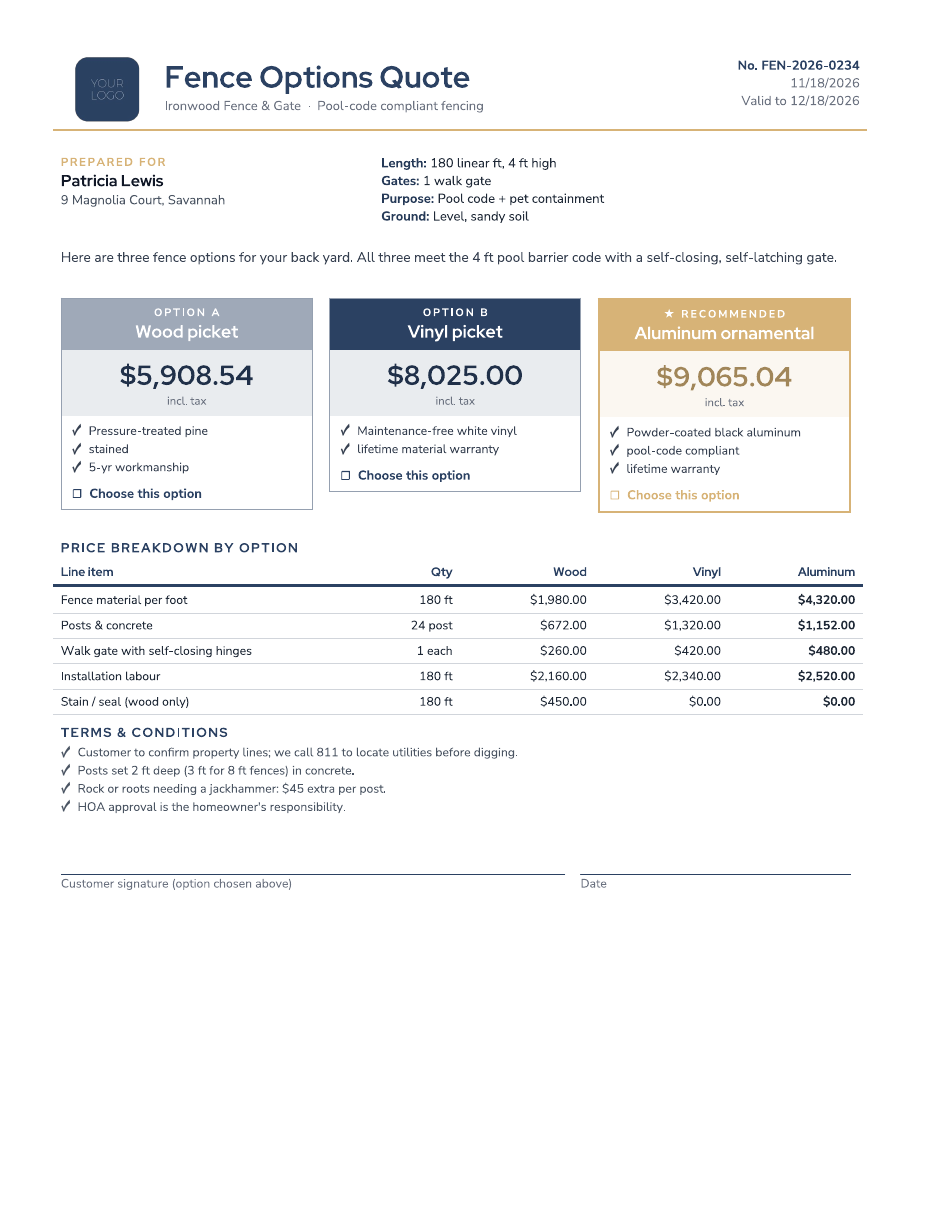
Navy and sand option cards comparing wood, vinyl and aluminium for the same 180 ft run, with the recommended material highlighted and a price breakdown for each. Best for letting customers pick a material.
Download Word (.docx)Download PDF4. Fence Repair Job Ticket
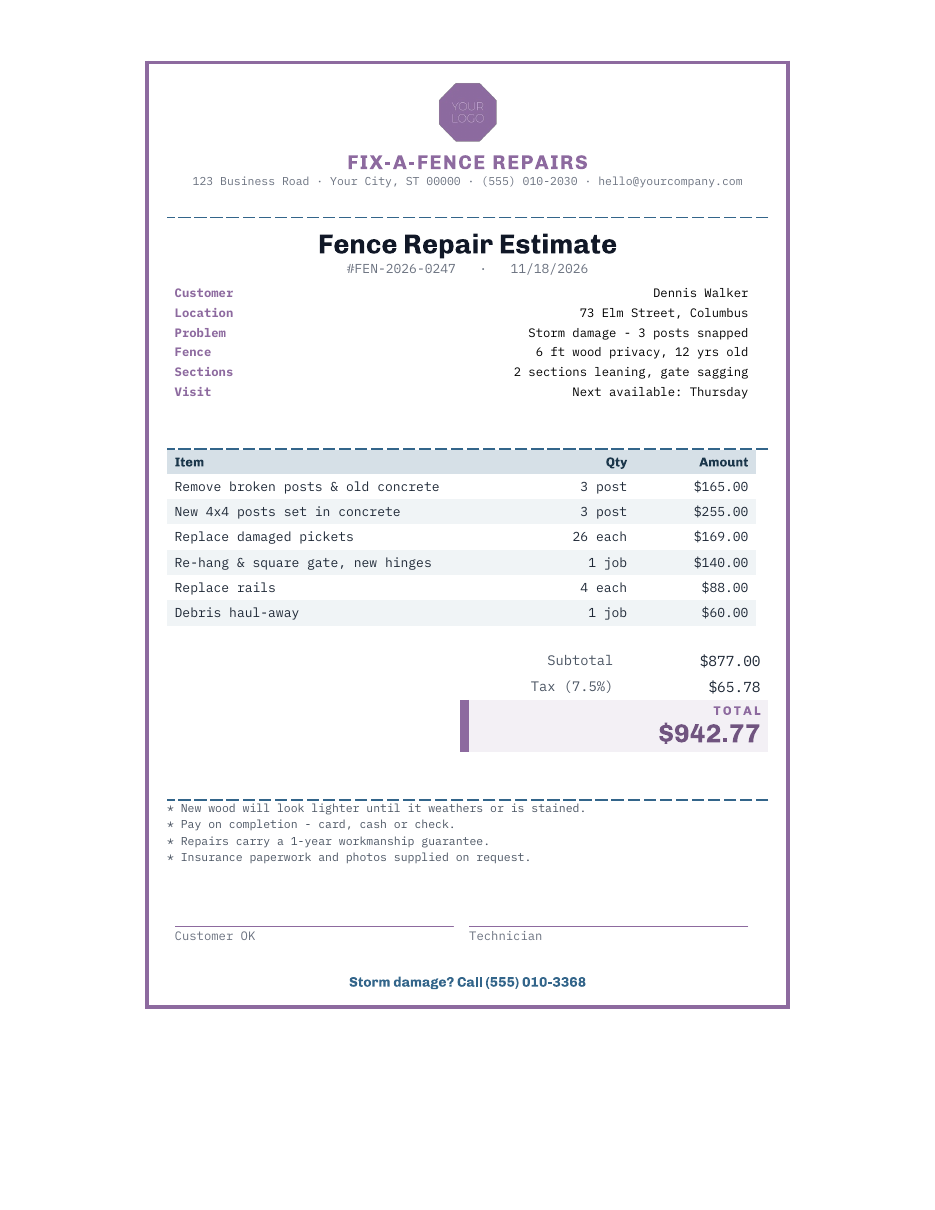
A compact lilac and blue job ticket in a typewriter font for storm damage and post replacement, with problem, fence age and visit fields and a short repair price list. Best for quick fence repairs.
Download Word (.docx)Download PDF5. Farm & Ranch Fencing Quote (Excel)
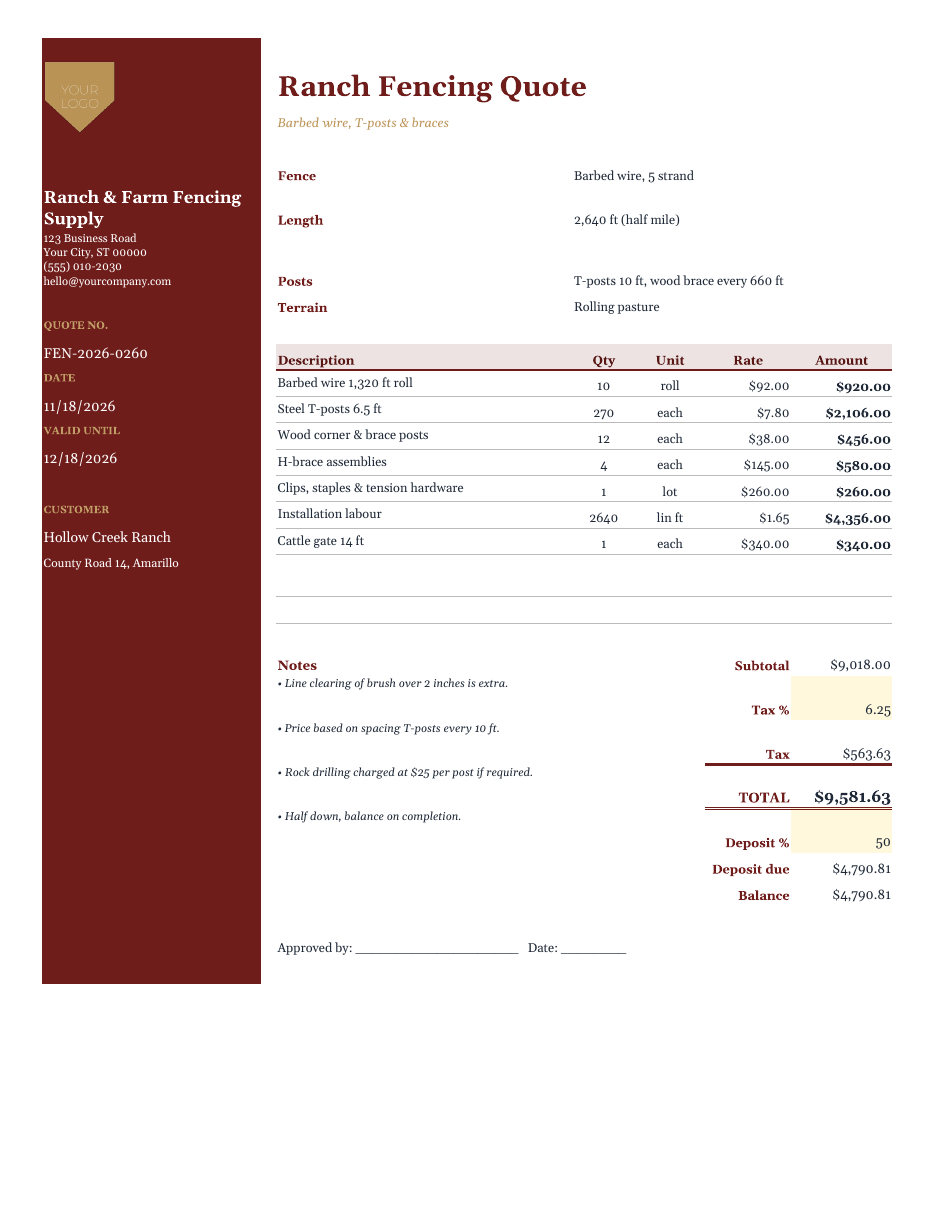
An oxblood sidebar Excel quote for agricultural fencing with wire rolls, T-posts, H-braces, gates and per-foot labour, plus formulas for subtotal, tax, total and deposit. Best for farm, ranch and acreage fencing.
Download Excel (.xlsx)Download PDFWhat Is a Fence Estimate?
A fence estimate is a written price from a fencing contractor to supply and install a new fence, replace an old one or repair storm or age damage. It describes the fence style, height and material, the total linear feet, the posts, gates and hardware, the installation method, removal of the old fence and the total price. A good estimate also notes who is responsible for property lines, permits, HOA approval and utility locates, because these are the issues that cause most fence disputes.
What to Include in a Fence Quote
- Contractor details: company name, logo, licence and insurance, and contact details.
- Customer and property: name, address and the parts of the yard being fenced.
- Fence specification: material (wood, vinyl, aluminium, chain link, composite or wire), style, height, colour and post size.
- Measurements: the length of each run in linear feet, the total, the number of corners and the ground slope.
- Posts and footings: post spacing, depth, and concrete or gravel setting.
- Gates: number, width, hardware, self-closing hinges and latches, and double drive gates.
- Removal: tearing out and hauling away the old fence, and clearing brush or roots along the line.
- Site conditions: slope, rock, tree roots, and whether the fence is stepped or racked.
- Permits and approvals: building permit, HOA approval, pool code requirements and the 811 utility locate.
- Terms: deposit, payment on completion, warranty on workmanship and materials, and validity date.
How to Estimate a Fence Job
Step 1: Measure every run
Walk the fence line with a measuring wheel and record each straight run separately. Note corners, ends and gate openings. The calculator and the Excel estimator total the runs for you.
Step 2: Count posts and sections
Divide each run by the post spacing, usually 6 or 8 feet, round up and add one end post. Corners and gate posts are often heavier and priced separately. Each post typically needs one to two bags of concrete.
Step 3: Count panels or pickets and rails
For panel fences, the number of sections equals the number of spaces between posts. For board-on-board or picket fences, divide the length in inches by the picket width plus gap to get the picket count, and allow two or three rails per section depending on height.
Step 4: Price materials, labour and gates
Price the posts, panels or pickets, rails, hardware and concrete from your supplier list, or use an installed price per linear foot if your crews work that way. Add gates as separate lines and include labour per linear foot or per day.
Step 5: Add removal, extras and margin
Add removal and disposal of the old fence per linear foot, extra for rocky ground or hand-digging, and any permit fees. Then add overhead and profit.
Fence Estimate Example
A sample estimate for a 6 ft wood privacy fence along three sides of a back yard, 210 linear feet in three runs with one walk gate:
- 31 posts set in concrete at $45: $1,395
- Pickets, rails and hardware at $14 per linear foot: $2,940
- Installation labour at $11 per linear foot: $2,310
- 4 ft walk gate with hardware: $320
Total $6,965, about $33 per linear foot before tax. Adding removal of an old chain-link fence at $3.50 per foot would add $735.
Wood, Vinyl, Aluminium and Chain Link
Each material changes the quote. Wood is the cheapest privacy fence to install but needs staining or sealing, so many contractors offer stain as an option. Vinyl costs more for materials but less for maintenance, and panels are usually sold in 6 or 8 ft sections. Aluminium and ornamental steel are popular around pools because they meet barrier codes when paired with self-closing gates. Chain link is quick to install and often used for dogs and commercial sites. Offering two or three materials on one quote, as the options template does, helps customers choose without calling another contractor.
Farm and ranch fencing is a different market. It is quoted by the roll of wire, the number of T-posts and braces and a per-foot labour rate across long distances, which is why the ranch template is an Excel sheet with quantities in rolls and posts rather than panels.
Gates, Slopes and Other Price Drivers
Gates are the most common source of call-backs, so price them carefully. A walk gate needs heavier posts, a frame that will not sag, hinges and a latch; a double drive gate may need a drop rod, a wheel or a steel frame. Pool fences need self-closing hinges and latches mounted at the height required by local code. List each gate on its own line with its width and hardware so the customer sees exactly what is included.
Sloped ground also changes the price. Panels can be stepped down the slope, leaving triangular gaps underneath, or racked to follow the ground, which takes more cutting time. Rock, tree roots and hand-digging next to a building all slow the crew down. Note these conditions in the site notes, like the vinyl installation template does, and price them up front rather than discovering them on installation day.
Fence Repair Estimates
Repair calls are short but frequent: a post snapped in a storm, a sagging gate, a few broken boards or a section hit by a car. The fence repair job ticket is designed for quick visits. Record the problem, the age of the fence and the parts used, price the work and get a signature on the spot. For general small repairs, a work estimate template or job estimate template also works, and the hourly price quote template suits time-and-materials repairs.
Tips for Winning More Fence Jobs
- Make the customer confirm the property line. Put it in writing; you do not want to build a fence on the neighbour’s land.
- Call 811 before digging. Note the locate ticket number on the quote.
- Explain post depth. Customers comparing prices rarely know that deeper posts in concrete last longer; tell them why your price is higher.
- Show the price per foot. It makes your quote easy to compare and shows you have nothing to hide.
- Include a sketch or photo. Mark runs, gates and corners on an aerial photo of the yard.
- Follow up quickly. Fence season is short in many areas, so call within two days of sending the quote.
For bigger fencing contracts on building sites, the construction quote template and bid quote template add the formal structure general contractors expect.
Frequently Asked Questions
How do I estimate the cost of a fence?
Measure the total linear feet, count the posts by dividing each run by the post spacing and adding one, then price posts, panels or pickets, rails, concrete, gates and labour. Add removal of any old fence, permit fees and your margin. The calculator on this page does the counts for you.
How many posts do I need for a fence?
Divide the length of each straight run by the post spacing, round up and add one. A 64 ft run with 8 ft spacing needs 9 posts. Corners shared by two runs are counted once.
What should a fence quote include?
It should include the fence material, style and height, the total linear feet, number of posts and gates, how posts are set, removal of the old fence, permits and approvals, the price and the payment terms.
Is there a fence estimate template in Excel?
Yes. The linear-foot estimator and the farm and ranch fencing quote are Excel workbooks with formulas for quantities, line totals, tax and deposit. Both also open in Google Sheets.
Should fence quotes be per foot or a total price?
Give a total price for the job, but also show the price per linear foot. Customers compare fencing contractors this way, and it makes changes in length easy to price.
Who is responsible for property lines and permits?
Normally the property owner is responsible for confirming boundary lines and HOA approval, while the contractor arranges the utility locate and, often, the permit. Put these responsibilities in the terms of your fence quote.
