

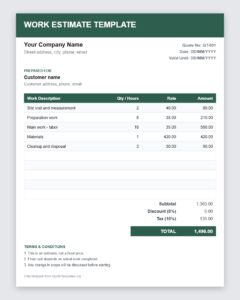
Price the work before you pick up a tool. This free work estimate template helps contractors, freelancers, repair technicians and service providers give customers a clear estimate for labor, materials and other costs. Download it, fill in the details of the job and send a professional work estimate in minutes.
What Is a Work Estimate?
A work estimate is a written calculation of what a job is expected to cost. It describes the work to be done, the time it will take, the materials required and the total price, so the customer can decide whether to hire you. Work estimates are used in construction, home repair, painting, landscaping, cleaning, maintenance, design and countless other trades. A good one gives customers confidence and gives you a record of what you promised.
Work Estimate vs. Quote vs. Invoice
An estimate is an educated approximation of cost and can change if the job turns out different from expected. A quote is a fixed price for a defined scope. An invoice is the bill you send after the work is finished. If you use an estimate, say clearly what could change the final price, such as hidden damage, additional requests or price changes for materials.
What to Include in a Work Estimate
- Your business details: name, logo, address, phone, email and license number if required.
- Customer details: name, contact information and job site address.
- Estimate number and date: so it can be matched to the final invoice.
- Description of the work: a list of tasks in plain language.
- Labor: the number of hours and hourly rate, or a flat price per task.
- Materials and supplies: each item with quantity and cost.
- Other costs: equipment hire, disposal, permits, travel and delivery.
- Taxes and total: the subtotal, tax and estimated total.
- Timeline: the expected start and completion dates.
- Validity and terms: how long the estimate is valid, payment schedule and a signature line for approval.
How to Write a Work Estimate Step by Step
- Understand the job. Visit the site if you can, take measurements and ask the customer what result they expect.
- Break the work into tasks. Write each step down so nothing is missed.
- Estimate time and materials. Use your experience and current supplier prices, and allow a little for waste.
- Add overhead and profit. Cover tools, transport, insurance and a fair margin.
- Enter the figures in the template. Check every total.
- Explain the estimate to the customer. Walk through the main items and answer their questions.
- Follow up. A short message a few days later shows that you are interested in the job.
Tips for Accurate and Competitive Estimates
Keep records of your past jobs so you can compare actual costs with your earlier estimates and improve your accuracy. Do not underprice to win a job, because low estimates often lead to lost profit or rushed work. Equally, do not hide your costs; customers appreciate a fair, itemized price. Offer options, such as standard or premium materials, so the customer can choose what suits their budget. If the scope changes during the job, provide a written change estimate before doing the extra work.
Common Mistakes to Avoid
Frequent errors include vague descriptions, forgotten materials, no expiry date, unclear payment terms and arithmetic mistakes. Another common problem is failing to state exclusions, which can lead to disagreements about what was included. Using a template solves many of these issues, because the structure reminds you to include every important item.
Who Can Use This Work Estimate Template?
Carpenters, plumbers, electricians, painters, landscapers, cleaners, mechanics, handymen, freelancers and small contractors can all adapt this template. It is also useful for homeowners who want to compare several estimates for the same job.
How to Use This Template
Download the file using the button below and save a copy on your computer. Replace the sample information with your own, add the tasks, hours and materials, and confirm the totals. Print the estimate on your letterhead or save it as a PDF and send it by email. Keep the blank original so every new estimate starts from a clean file.
Sample Wording You Can Use in a Work Estimate
Clear wording avoids arguments. For the scope, you might write: This estimate covers the supply and installation of the items listed above during normal working hours. For changes, you can add: Any additional work requested after approval will be quoted separately. For validity, state: This estimate is valid for thirty days from the date shown. Short, plain sentences like these make the document easy to read and easy to accept, and you can paste them into the notes section of your template.
Download Free Work Estimate Templates
:



Download Free Work Estimate Template (Excel)

Frequently Asked Questions About Work Estimates
Is a work estimate legally binding?
Generally no. An estimate is an approximation, while a quote is a firm price. Label the document clearly so the customer knows which one they are receiving.
Should I charge for work estimates?
Many tradespeople offer free estimates for small jobs, while complex projects that require long site visits may involve a fee. Tell the customer before you begin.
How long should an estimate be valid?
Thirty days is common. Use a shorter period when material prices change quickly, and always print the expiry date.
What if the job costs more than the estimate?
Tell the customer as soon as you notice, explain why and get approval before continuing with the extra work.
Can I use this template for different trades?
Yes. Change the descriptions, labor categories and materials to suit your trade.
Can I convert an accepted estimate into an invoice?
Yes. After the work is finished, copy the final labor and material costs into an invoice and add your payment instructions.

