
Quotes, estimates and invoices all show prices, so it is easy to mix them up. But they do different jobs, carry different legal weight and are sent at different stages of a sale. Understanding quote vs estimate vs invoice helps you set the right expectations, avoid payment disputes and get paid faster. This guide explains each document in plain English, compares them side by side, and gives you five free quote, estimate and invoice templates plus a generator that writes the right wording for you.
Choose a document type in the generator, add your line items and it will produce ready-to-paste text with the correct totals, price range, validity or due date.
Free Quote, Estimate & Invoice Generator
Pick the document type, add your line items and get ready-to-paste wording with the right totals, validity, range or due date for a quote, estimate or invoice.
| Item / service | Qty | Unit price | Amount | Remove |
|---|
Edit the generated text as needed before sending. Nothing you type is saved or sent anywhere.
5 Free Quote, Estimate & Invoice Templates
Download a matching set of business documents, each with a different design: a formal quotation letter for fixed prices, a project estimate that shows the estimated total first, a professional invoice with payment details, an Excel pro forma invoice for deposits and customs, and an Excel quote-to-invoice workbook whose Invoice tab fills itself in from the Quote tab. Excel versions calculate totals, tax and deposits automatically. All are free and work in Word, Excel, Google Docs and Google Sheets.
1. Formal Quotation Letter (Quote)
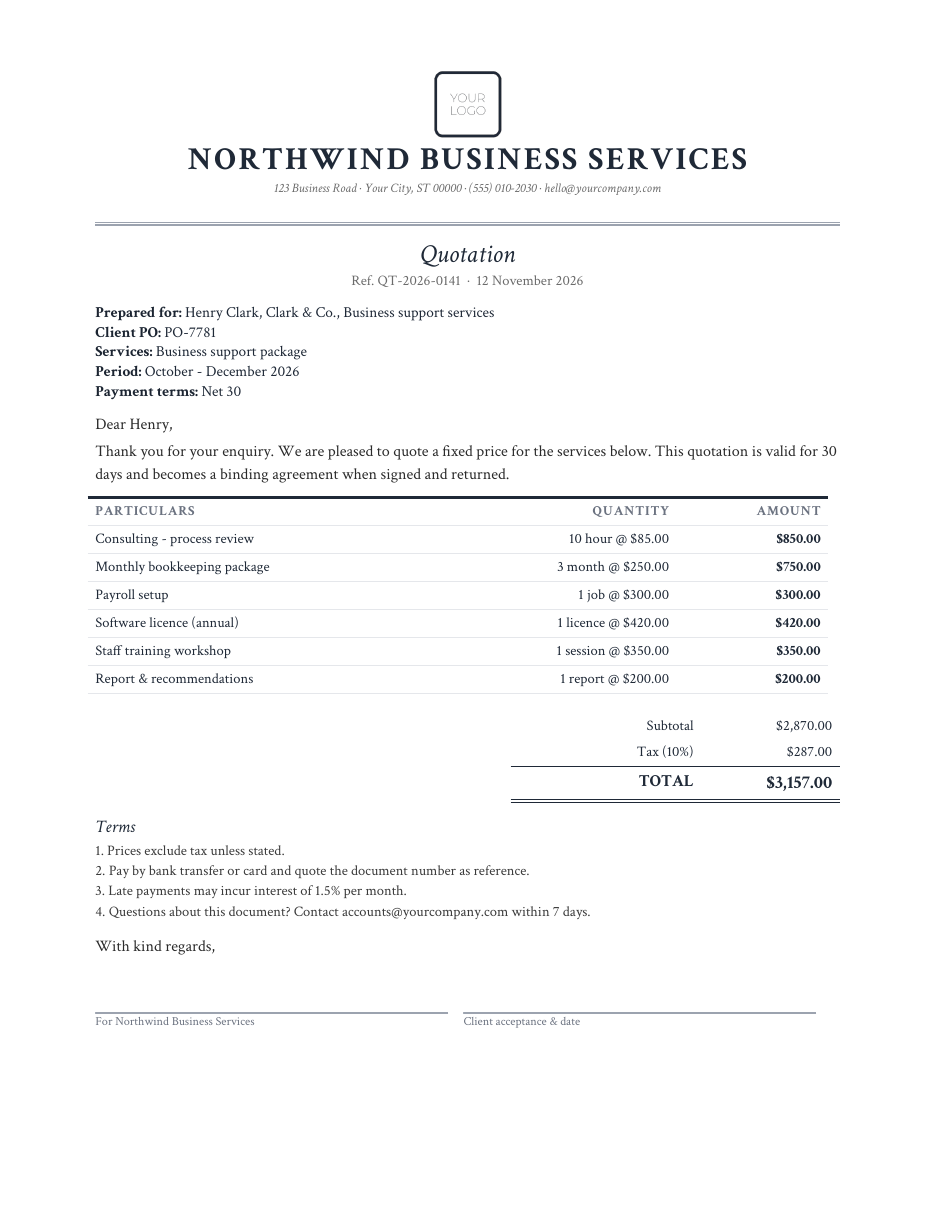
A fixed-price QUOTE in a formal letter format: centred letterhead, covering letter, particulars table, validity date and an acceptance signature that turns it into an agreement. Use when you can commit to a fixed price.
Download Word (.docx)Download PDF2. Project Estimate (Total First)
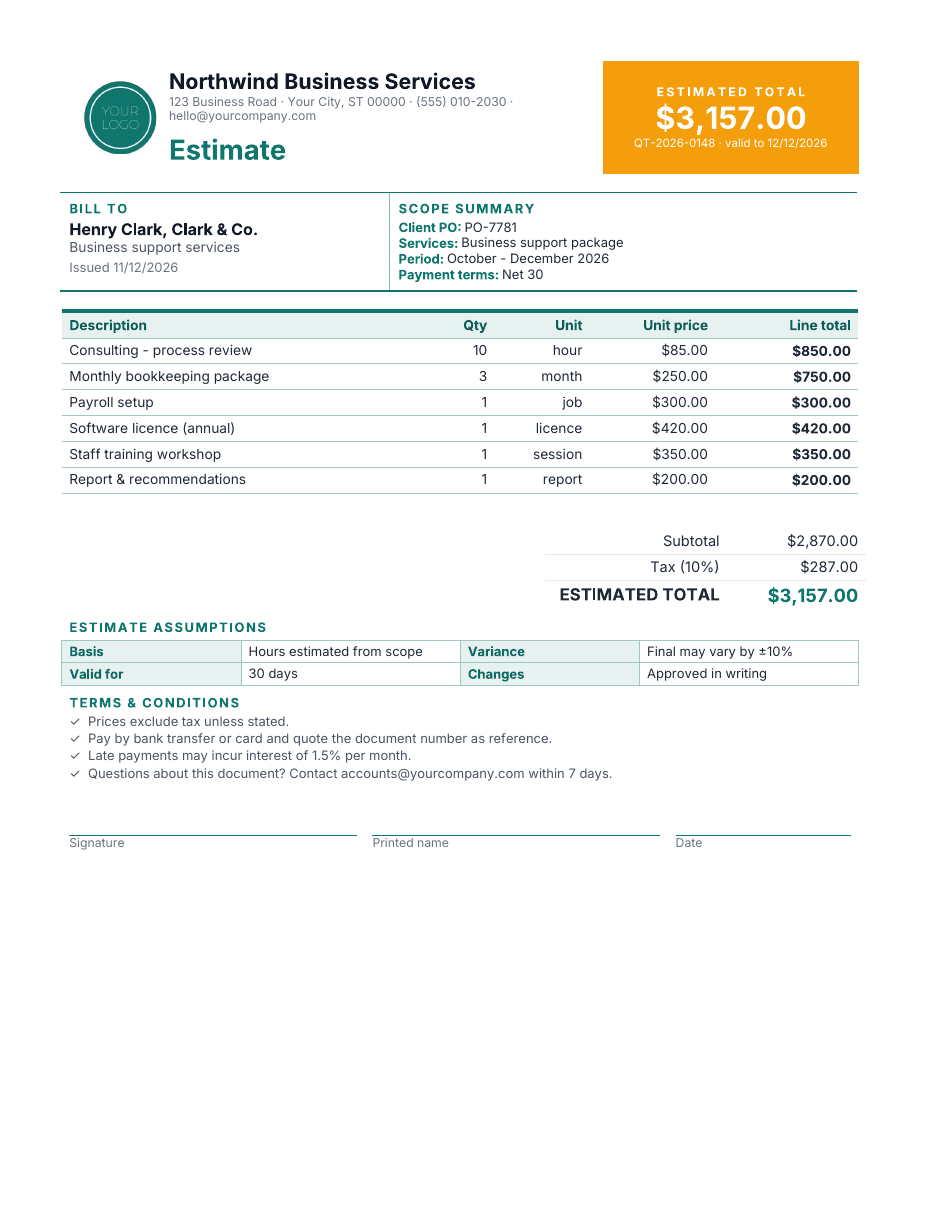
An ESTIMATE that shows the estimated total in a badge at the top, a scope summary, line items and an assumptions box stating the basis, the allowed variance and the validity period. Use when the final cost may change.
Download Word (.docx)Download PDF3. Professional Invoice
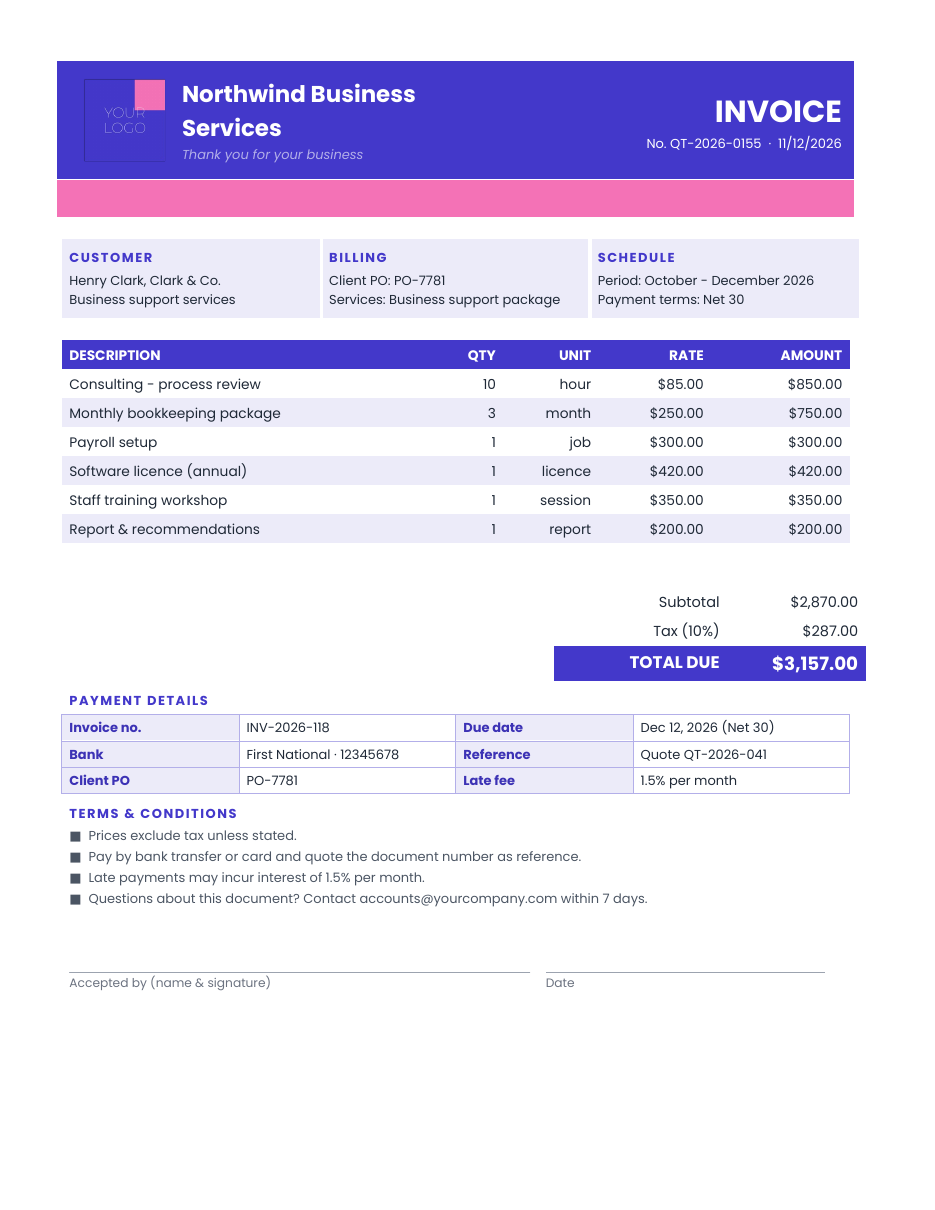
An INVOICE with an indigo header band, billing details, striped line items, a Total Due bar and a payment details block (due date, bank, PO and quote reference, late fee). Use after the work is done to request payment.
Download Word (.docx)Download PDF4. Pro Forma Invoice Form (Excel)
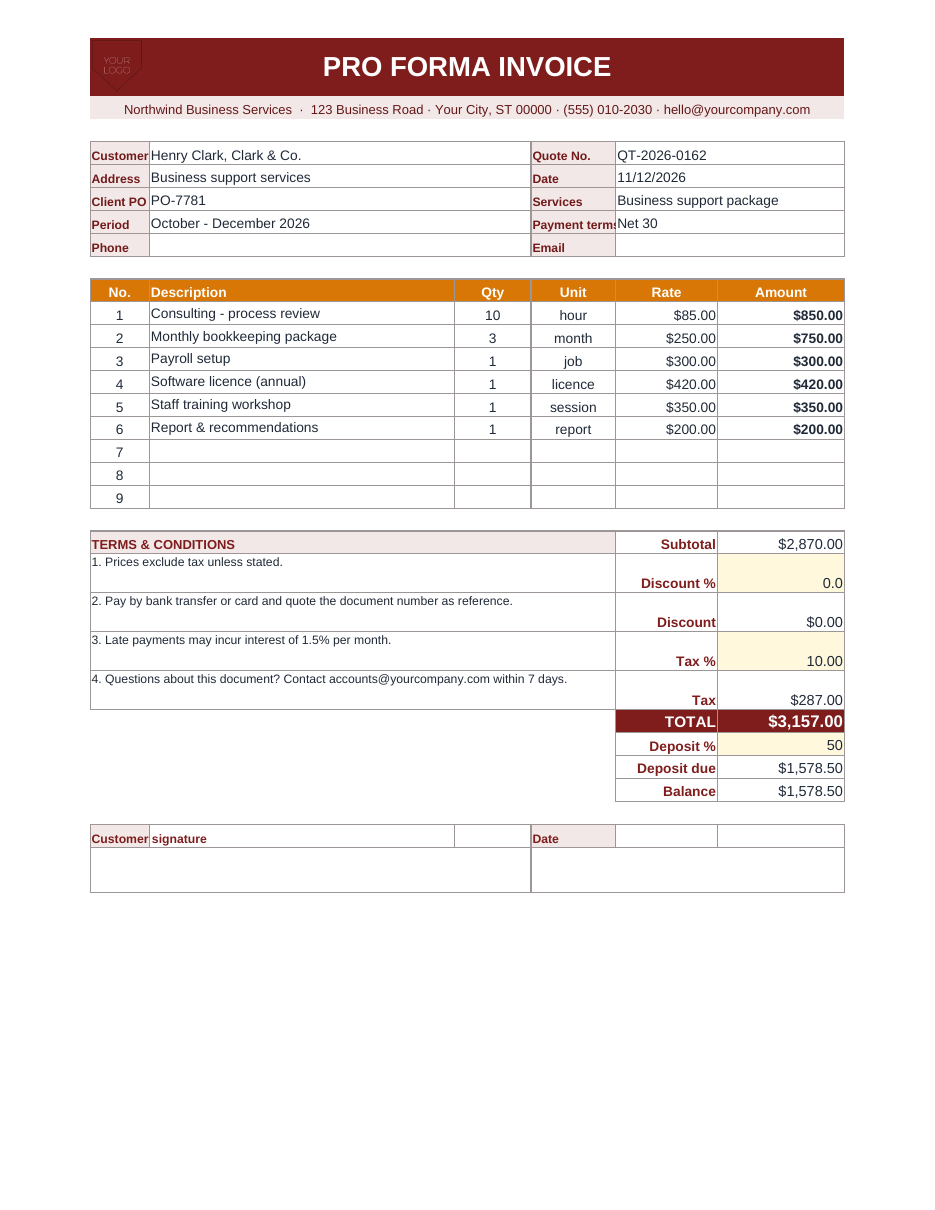
A boxed PRO FORMA invoice in Excel for advance payments and customs, with buyer details, numbered items, totals, a 50% advance and balance, and signature boxes. Use to request a deposit before supplying goods.
Download Excel (.xlsx)Download PDF5. Quote-to-Invoice Workbook (Excel)
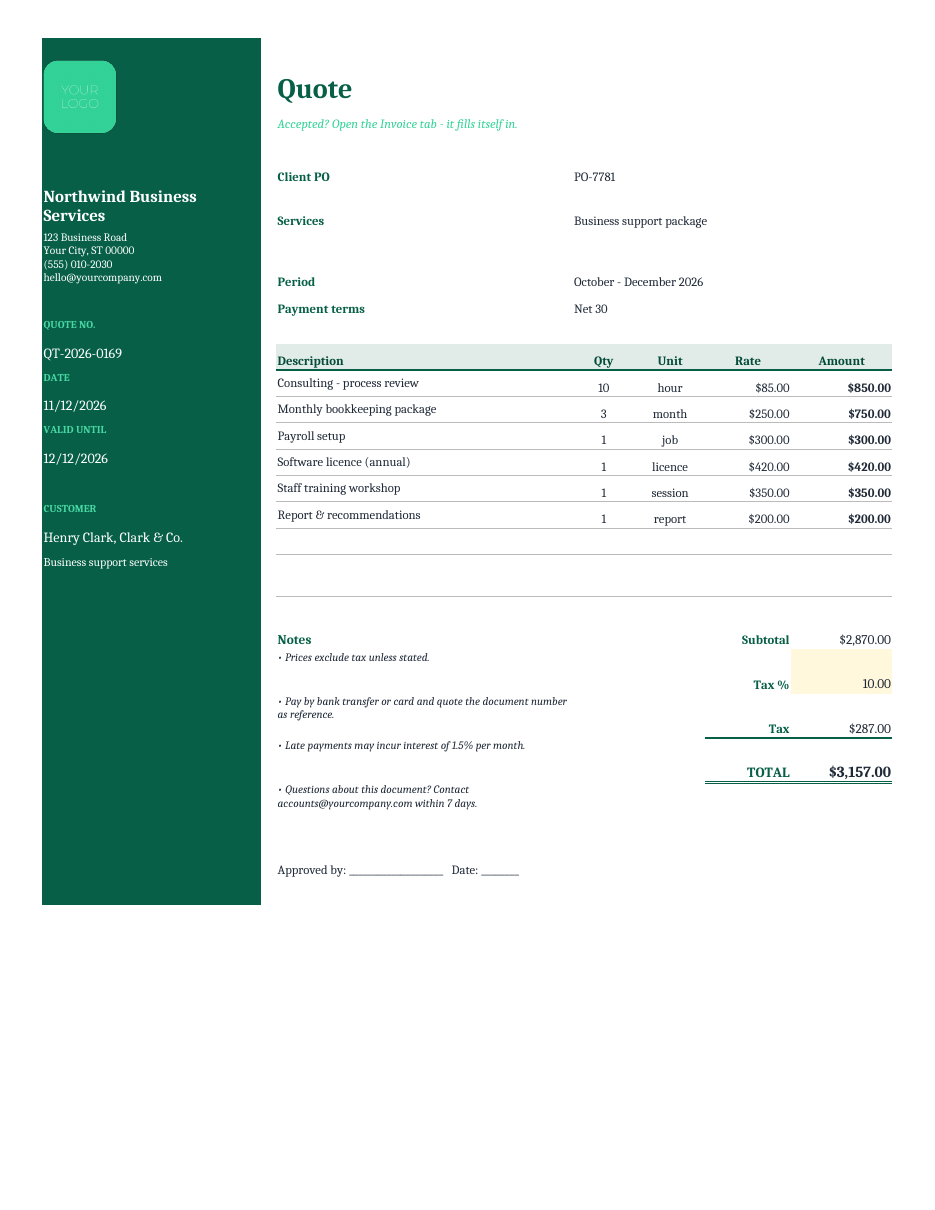
A two-tab Excel workbook: fill in the Quote tab, and once the client accepts, the Invoice tab pulls the same client, items and totals automatically so you never retype a line. Use to turn an accepted quote into an invoice.
Download Excel (.xlsx)Download PDFWhat Is a Quote?
A quote (or quotation) is a fixed price offer for specific goods or services. It tells the customer exactly what you will provide and what it will cost, and it is usually valid for a set period such as 30 days. If the customer accepts the quote, the price is agreed and, in many jurisdictions, can form a binding contract. Quotes are best when the scope is clear: selling products, fixed-price services or standard jobs. See our price quote templates, sales quotation templates and the full 60+ quotation templates collection.
What Is an Estimate?
An estimate is an educated guess of what a job will probably cost, based on the information available. It is not a fixed price, and the final cost can change if the scope or conditions change. Estimates are common in construction, repairs and creative work where the full job is not known until work starts. Good practice is to give a likely range and promise to contact the customer before going over it. Browse our construction estimate templates, job estimate templates and work estimate templates.
What Is an Invoice?
An invoice is a request for payment sent after goods are delivered or services are completed. It records what was supplied, the amount owed, tax, the payment due date and how to pay. Invoices are accounting and tax records, so they need a unique invoice number, your business details and, where applicable, your tax or VAT number.
Quote vs Estimate vs Invoice: Comparison
- Purpose: a quote offers a fixed price; an estimate gives an approximate cost; an invoice requests payment.
- When it is sent: quotes and estimates are sent before work starts; an invoice is sent after delivery or at agreed milestones.
- Price certainty: a quote is fixed for its validity period; an estimate can change; an invoice is final.
- Legally binding: an accepted quote can be binding; an estimate is usually not; an invoice records a debt the customer owes.
- Key fields: quotes show a validity date and acceptance signature; estimates show assumptions and a price range; invoices show an invoice number, due date and payment details.
- Next step: a quote or estimate becomes an order or contract once accepted; an invoice is closed when paid.
Quote vs Estimate: Which Should You Use?
Use a quote when you can price the work precisely, such as selling 50 chairs, a website package or a standard service. Use an estimate when there are unknowns, such as a roof that may have rotten decking, a plumbing leak behind a wall or a design project whose scope will evolve. Many trades do both: a rough estimate on the first call, then a firm quote after a site visit. Our new trade templates show this in practice, including the roofing estimate template, plumbing quote template, electrical quote template and painting quote template.
Estimate vs Invoice
An estimate comes at the start and an invoice at the end. Your invoice should reference the original estimate or quote number and explain any differences, such as approved extra work. Clear links between the two documents reduce questions and speed up payment.
Bid, Proposal and Pro Forma Invoice
A few related documents often cause confusion:
- Bid or tender: a formal price submitted in competition with others, usually for a project with a set specification. See our bid quote template.
- Proposal: a longer document that explains your approach and value as well as the price, common for agencies and consultants.
- Pro forma invoice: a preliminary invoice sent before delivery, often for international shipments or deposits. It is not a tax invoice.
- Quotation letter: a formal cover letter that presents your quote. Try our quotation letter templates.
How the Documents Flow in a Typical Job
- The customer asks for a price.
- You send an estimate if the scope is uncertain, or a quote if it is clear.
- The customer accepts and signs, often paying a deposit.
- You complete the work, agreeing any changes in writing.
- You send an invoice that matches the accepted quote plus approved changes.
- The customer pays and you mark the invoice as paid.
For service businesses, the same flow applies whether you run a cleaning service, a landscaping business, a web design studio, a catering company or a moving company.
Tips for Using Quotes, Estimates and Invoices
- Number everything. Use a consistent numbering system, for example Q-2026-001 for quotes and INV-2026-001 for invoices.
- Set an expiry date on quotes. Prices for materials change, so 30 days is a sensible default.
- Show a range on estimates. A range such as plus or minus 10% sets realistic expectations.
- Put payment terms on invoices. Net 7, Net 14 or Net 30, plus bank details and accepted payment methods.
- Keep the layout consistent. Using matching templates looks professional and builds trust. Our Word quote templates and Excel quotation templates make this easy.
Which Document Should You Send? Real Examples
- A plumber fixing a known leak sends a quote with a fixed price, because the work is clear.
- A builder renovating an old kitchen sends an estimate, because hidden problems behind the walls may change the cost.
- A web designer sends a quote or proposal with a payment schedule, then an invoice at each milestone.
- An exporter shipping goods overseas sends a pro forma invoice so the buyer can arrange payment and customs first.
- A cleaner on a monthly contract quotes once, then sends a recurring invoice each month.
Common Mistakes With Quotes, Estimates and Invoices
- Calling a document an estimate when you mean to commit to the price, or a quote when the price may change.
- Leaving out an expiry date, so a client accepts an old price months later.
- Sending an invoice without the quote number, PO number or due date, which slows payment.
- Changing the scope without a written change order, so the invoice no longer matches what was agreed.
- Using one numbering system for everything. Prefixes such as Q-, EST- and INV- make every document easy to trace.
What to Include on Each Document
- Quote: your details, the client’s details, a quote number and date, the scope, itemized prices, taxes, the total, an expiry date, terms and an acceptance signature.
- Estimate: everything a quote has, plus the assumptions behind the price and how much the final cost may vary.
- Invoice: an invoice number, the invoice date and due date, the items delivered, tax, the total due, payment methods, the quote or PO reference and, where required, your tax registration number.
Keeping the same layout across all three documents makes your business look organized and helps clients follow the paper trail from offer to payment.
Frequently Asked Questions
Is a quote legally binding?
An accepted quote can be legally binding because it is a fixed offer that the customer has accepted. Always state the validity period and terms on your quotes, and check the rules in your country.
Can an estimate change?
Yes. An estimate is an approximate price. It is good practice to explain the assumptions and to get the customer’s approval before exceeding the estimate by a significant amount.
Do I need to send a quote before an invoice?
No, but it is strongly recommended for larger jobs. A quote or estimate agreed in advance prevents disputes when the invoice arrives.
What is the difference between a quotation and a quote?
There is no real difference. Quotation is the more formal term and quote is the everyday short form.
Can I convert a quote into an invoice?
Yes. Copy the accepted line items into an invoice, add an invoice number, date, due date and payment details, and reference the original quote number. The quote-to-invoice Excel workbook above does this for you: its Invoice tab pulls the client, items and totals from the Quote tab.
Should an invoice show the quote number?
Yes. Putting the original quote or estimate number and the client’s PO number on the invoice lets the client match the bill to what they approved, which speeds up payment.
